
At the beginning of the 20th century, there had been many discussions surrounding the legislative
establishment of the University of Reading and how it would physically come to be. The working class
was a point of this, and how the university could connect with these students from the start of the
university onwards, growing its ranks from around c.1500 students to a staggering c.27,000 students
in 2026.
From the Outreach Programme of Oxford University, the creation of University College, Reading
provided an accessible way for students from further parts of the country to be part of a bigger
Oxford University. This broke down the barriers surrounding the institution’s exclusivity, leading
the way towards an inclusive place for students of all classes to expand their knowledge of their
chosen studies. From the University College came the University of Reading in 1926, where more
students were able to attend its campus with new student accommodation buildings and a bigger
campus, benefiting both students and staff alike.
This section explores both the University College, Reading and the beginnings of the University
of
Reading to show the basis of how the working class was formed in the institution.
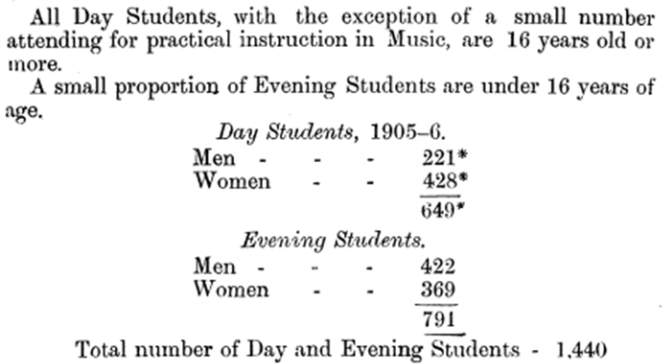
Board of Education, Reports from those Universities and University College in Great Britain
which
participate in the Parliamentary Grant (London, 1907)
https://babel.hathitrust.org/cgi/pt?id=mdp.39015076593857&seq=5
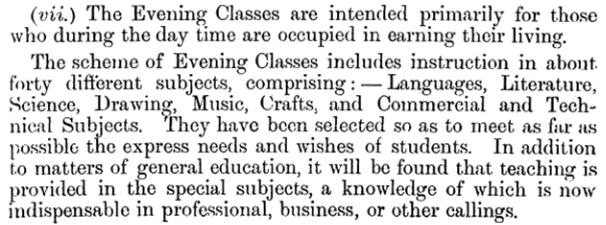
Board of Education, Reports from those Universities and University College in Great Britain
which
participate in the Parliamentary Grant (London, 1907)
https://babel.hathitrust.org/cgi/pt?id=mdp.39015076593857&seq=5
At 5 years old, the University College, Reading had cemented itself into
Reading Town’s structure as part of the Outreach Programme of Oxford, where students from all
backgrounds were able to come and support their learning to the fullest with resources from their parent
institution, but especially a grant from the government; the grant supported many different universities
and university colleges where each institution had to spell out to the government where the money was
going to best grow each place.
These extracts from a report to the British government demonstrated how the resources best supported
all
students, whether during the day or in the evening. There was an even split between the day and evening
courses for both genders, as many people were engrossed in work during the normal 9-5 hours per day.
This meant that working-class students were able to finish their workday and continue their courses
after it had finished, so vital learning for their chosen subject was not missed.
Furthermore, in the second source, they ‘have been selected to meet as far as possible the express
needs
and wishes of students’, meaning that the evening classes were tailored to the students who need support
in the areas of languages, literature, science, drawing, music, crafts and commercial and technical
subjects. All these subjects were offered for students who needed degrees in certain aspects of the
workplace and saw their studies as a parallel to the industries they were in; the working class were
able to study effectively alongside jobs to push their careers into higher rankings.
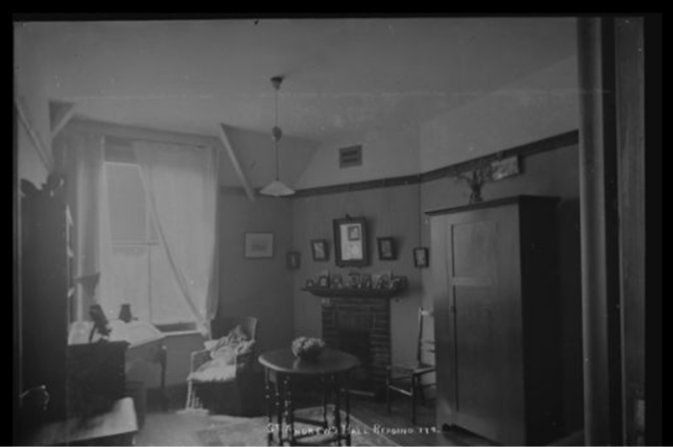
Interior of St Andrew's Hall, University College Reading via M.E.R.L. (c1880-1930)
Dann-Lewis Photographic Collection. P DX322 PH1/DL/779.
University of Reading, Whiteknights,
Reading, Berkshire,
RG6 6AH.
Student accommodation in University College, Reading, was well suited to the
early 20th-century student, drawing many parallels with how students live at the University in the 21st
century. Living at their own place of education meant that students on full-time courses could throw
themselves into their studies, with dedicated spaces for research, which shows how much they have in
common with today’s body of students.
For the working class, there were benefits to the cost of living there: per week, students used to
pay
between £1 and 1 shilling to £1 and 10 shillings and in 2026 terms, it meant they paid between
c.£45-£105. Compared to Reading in 2026, this is significantly less to pay; however, government support
has increased over the years through student grants and loans, so students from all backgrounds were
able to receive university-level education from their own spaces in university accommodations. This
built more interest in students and paved the way for more inclusive thinking surrounding the cost of
living for the working class at University College, Reading.
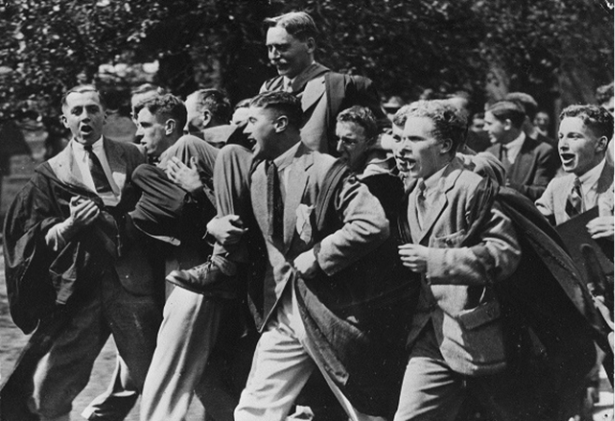
The students chaired the Principal, Dr William M Childs, in celebration, Reading (30 May 1925),
via
University of Reading, ‘Our Alumni Centenary Census’,
University of Reading Website
[website],
https://census.reading.ac.uk/
(11 January 2026).
Dr William M. Childs was an influential figure as the principal of the
University College, Reading, but also a driving factor towards the University of Reading’s creation in
1926.
This image, taken on the 30th May 1925, 10 months before the change happened, saw students ‘chair’
the
principal on their shoulders as a celebration for the Royal Charter’s terms being agreed in many talks
that started since the turn of the century.
The act of ‘chairing’ Childs meant that student support sought popularity from the change from
university college to university, bringing many more opportunities for students to achieve their
academic goals in their lives. Working-class students benefitted significantly from this as paths were
set in place for the future of students attending to the university to how we know of them today.


Reformed Charter of Incorporation of the University of Reading (August 2015),
via University of Reading
https://www.reading.ac.uk/about/governance/royal-charter
The Royal Charter was originally signed and sealed in 1926, with key parties
from the University of Reading, the Privy Council, and others present at the signing. In 2015, this
charter was reformed to bring it up to date with the University's own Strategy for 2020-2026. The
benefit for the working class was that the revised points significantly supported the working class.
Certain parts, such as the Equality section, were especially important, as the reasoning around
inequality was updated to modern standards. The Students’ Union is also important, as it’s a place for
students to go for help, queries and support, both within and outside the university, and has been a
significant place for decades.