
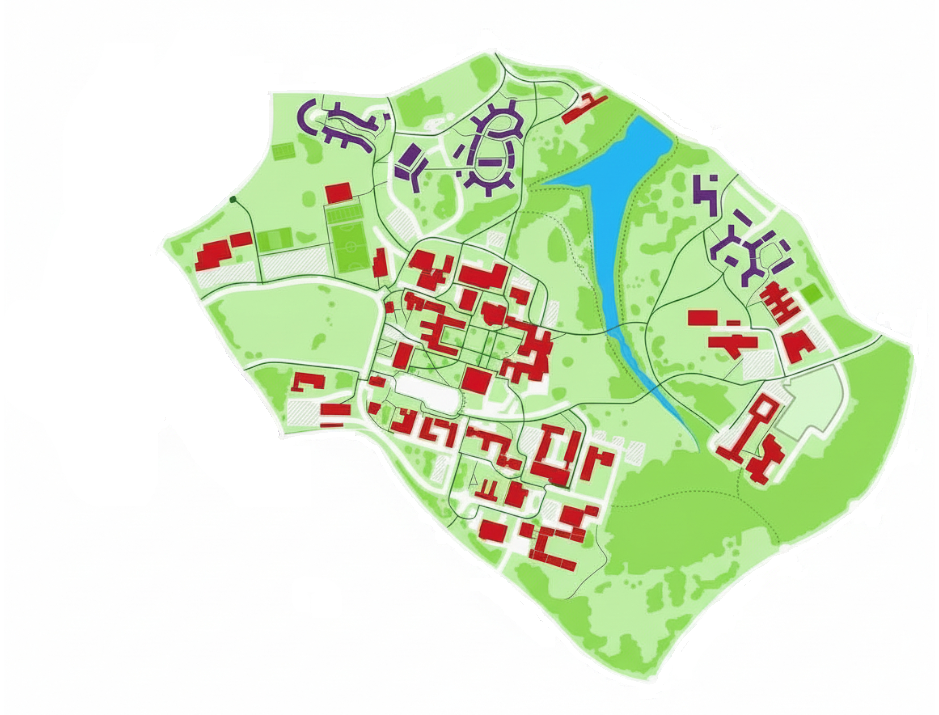
WhiteKnights Campus
London Road Campus
The Whiteknights Campus
Mackinder Halls
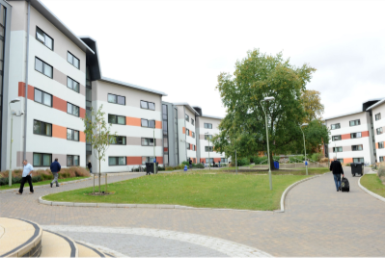
A Photograph of present-day Mackinder Hall.
From: ‘Mackinder Hall’, UPP, [website],
https://upp-ltd.com/our-partnerships/university-of-reading/mackinder-hall/
(last accessed: 13/01/2026).
Mackinder Hall was opened in 2010 and named in honour of H J Mackinder the first principle of Reading University Extension College. In Mackinder's time classes were set up with the aim to allow the working population access to classes with them mostly being in the evenings or on a Saturday. Mackinder was thus a key figure in Reading's Working-Class History by making sure that the extension college had a working-class focus Thanks to Mackinder many of Reading's first students were working-class.
The Carrington Building
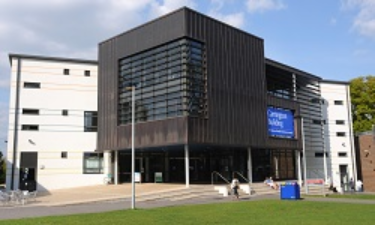
A photograph of the Carrington Building in 2018
From: ‘Prospective student reception at Carrington Building’,
University of Reading News Archive, [news archive], (7th November 2018),
https://archive.reading.ac.uk/staff-news/Pre-2019/spsn-786892.html
(last accessed: 13/01/2026).
The Carrington Building is named in honour of former Chancellor, Lord Peter Carrington, 6th Baron Carrington. The building is key to how the University addresses class today as it stands as a hub for all student support services. These include: the Student Financial Support Team, the Student Wellbeing Service and the Campus Jobs service. Many working-class students rely on this support. The Carrington building allows all these resources to be easily accessible.
The JJ Thompson Building
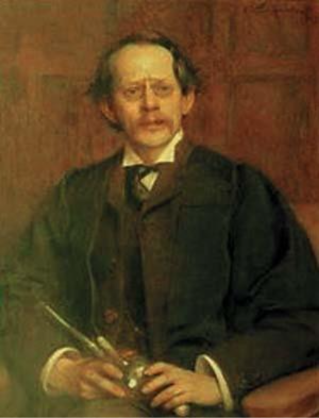
A 1903 portrait of Sir Joseph John Thomson by Arthur Hacker
From: I. Falconer,‘Thomson, Sir Joseph John,’ ,
Oxford Dictionary of National Biography, [website], (23rd September 2004),
https://www.oxforddnb.com/display/10.1093/ref:odnb/9780198614128.001.0001/odnb-9780198614128-e-36506
(Last accessed: 13/01/2026).
The JJ Thomson Building is named after Sir Joseph John Johnson, a notable physician who is credited with identifying the electron. He was awarded an honorary doctorate by Reading University in 1908. However, he faced many financial struggles as a student. Though being born into a middle-class family, after the death of his father in 1873, Thomson's family could no longer afford his engineering apprenticeship fees, and he had to rely on scholarships to continue his studies. JJ Thomson is a vital example of the mobility of class and the precarity of finances many families can face due to unforeseen circumstances. He highlights just how important scholarship schemes are.
The Students Union
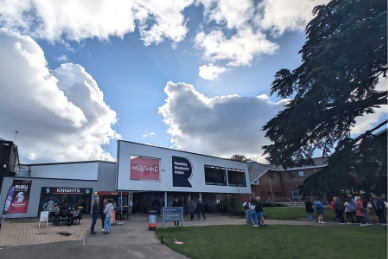
A Photo of the Students Union in 2024.
From: ‘SU Building Refurbishment Update’,
Reading Students Union, [website], (24th May 2024),
https://readingsu.co.uk/whats-on/articles/SU-Building-Refurbishment-Update
(Last accessed: 13/01/2026)
The Reading Students Union has existed for 100 years, ever since the University received its foundation charter in 1926. Ever since its inception it has been vital in campaigning for student rights, especially those of working-class students. It has been the leader of many protests such as in 1972 when the union led a protest the lowering of student grants and in 1973 when a rent strike was arranged to protest rising rent fees. These were issues intrinsically linked with working-class student experiences and shows how the Student Union has historically had working-class issues in mind.
The Library
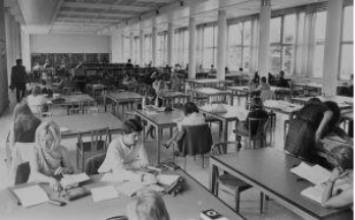
The interior of Whiteknights Library in the early 2000s,
From: ‘The History of the Library’,
Connected alumni magazine, [website], (27th February 2020),
https://sites.reading.ac.uk/connected/2020/02/27/the-history-of-the-library/
(last accessed: 13/01/2026).
The library has always been the beating heart of Reading. However, from our working-class student interviews we discovered how overwhelming such resources can be. Many past working-class students expressed how upon arriving on campus they didn’t know how to navigate the library and felt too embarrassed to ask. This led them to feel isolated and overwhelmed. This is something that has improved over recent years, with many courses often holding ‘How to use the library’ sessions.
The Harry Pitt Building
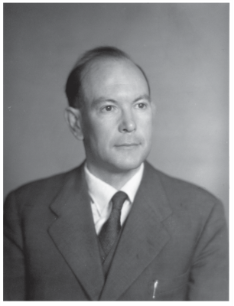
A Photograph of Harry Pitt
From: ‘The University Bulletin and the Harassment of the Vice-chancellor',
Tales from the archives: Snapshots of early academic life at Reading, [blog], (October 15th, 2025),
https://blogs.reading.ac.uk/tales-from-the-archives/2025/10/15/the-university-bulletin-and-the-harassment-of-the-vice-chancellor/
(last accessed: 13/01/2026).
The Harry Pitt Building is named after the past University Chancellor of the 1970s. Harry Pitt’s chancellorship was during the turbulent years of student protests over lowering grants and rising rents. In one such protest students attempted to lock him and others inside the staff common room!
The Harold Hopkins Building
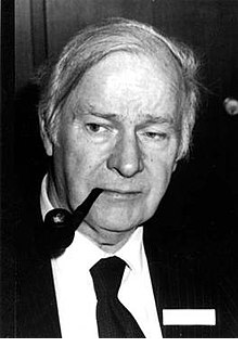
A Photograph of Harold Hopkins.
From: Careers Centre,‘Researchers Campus Buildings are named after,’,
Careers Blog, [blog], (11th November 2019),
https://blogs.reading.ac.uk/careers/researchers-campus-buildings-are-named-after/
(last accessed: 14/01/2026).
The Harold Hopkins building was opened in 2009 and was named in honour of Reading University's former chair of Optics, Harold Hopkins. Born in 1918, his family were working-class with his father often facing unemployment, so the family was often short of money. Despite this he received a good education gaining a scholarship to University College in Leicester. He went on to have a brilliant mathematical career. He is an excellent example of our past working-class staff members.
The Harry Nurnsten Building
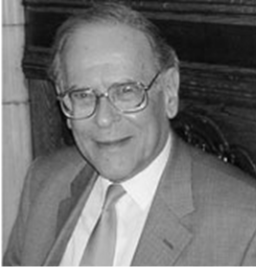
A photograph of Harry Nursten
From: Careers Centre,‘Researchers Campus Buildings are named after',
Careers Blog, [blog], (11th November 2019),
https://blogs.reading.ac.uk/careers/researchers-campus-buildings-are-named-after/
(last accessed: 14/01/2026).
The Harry Nursten building is named after the former head of Food Sciences, Harry Nursten. When he retired in 1970, he set up the Harry Nursten Postgraduate Scholarship which aims to encourage students from under-represented groups such as the working-classes to study food or nutritional science at postgraduate level.
Greenow Halls
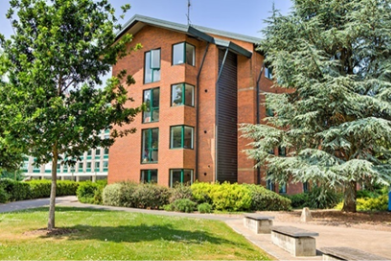
A Photograph of Greenow Hall.
From: ‘Greenow and McCombie’,
University of Reading, [website],
https://www.reading.ac.uk/ready-to-study/accommodation/locations/greenow-mccombie
(last accessed: 14/01/2026).
Greenow Hall, one of the affiliate halls of Windsor Hall is named after one of universities working-class professional staff members, Keith Greenow, head porter of Windsor Hall in 1976. He is fondly remembered for his support of resident students.
The Palmer Building
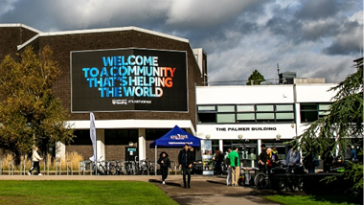
A Photograph of the Palmer Building.
From: Department of Economics,‘Explore economics at the University of Reading’,
, University of Reading, [website],
https://www.reading.ac.uk/economics/undergraduate/economics-campaign
(last accessed: 14/01/2026).
The Palmer Building is named after the infamous Palmer family of the Huntley and Palmer Biscuit Company. The Palmer family have long links with the history of Reading University. Back when Reading was an extension college the Huntley and Palmer biscuit company gave the buildings on London Road to the College to allow them to set up their first campus. The opportunity for the college to have its own campus was thus made possible by a company with a rich working-class background. The company employed more than 5,000 workers with the company's biscuit packet department specifically trying to hire unmarried men and women in need of work.
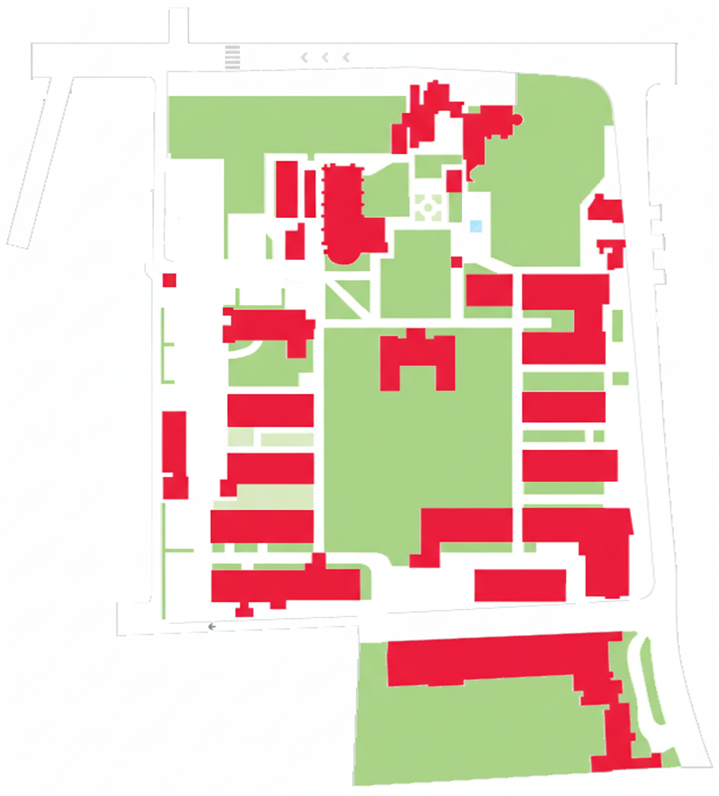
The London Road Campus
Museum of English and Rural Life
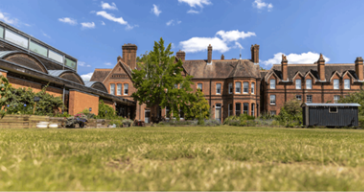
A Photograph of the MERL today.
From: O. Douglas, ‘What’s coming in 2026',
The Museum of English and Rural Life, [website], (5th January 2026),
https://merl.reading.ac.uk/news-and-views/join-our-big-rural-party-throughout-2026/
(last accessed: 14/01/2026).
The grand Victorian house that currently houses the popular Museum of English and Rural life was once named East Thorpe House and home to Alfred Palmer, business manufacturer of the Huntley and Palmer's business company. The company employed much of the working-class population of Reading and gifted the house to the University of Reading extension college for its first campus.
The L16 Building
A Photograph of Harry Pitt
From: ‘The University Bulletin and the Harassment of the Vice-chancellor',
Tales from the archives: Snapshots of early academic life at Reading, [blog], (October 15th, 2025),
https://blogs.reading.ac.uk/tales-from-the-archives/2025/10/15/the-university-bulletin-and-the-harassment-of-the-vice-chancellor/
(last accessed: 13/01/2026).
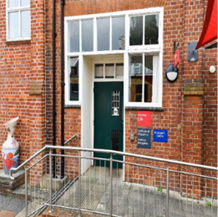
Few know that Building L16 once was a key location for Reading's working-classes in WW1. This is because the building housed a munitions training centre for creating materials for the war. By 1916, 157 working class men and women had been trained in the building and produced 4,000 shell bases and 200 maximal crosshead pins.
The Clock Tower War Memorial
Photograph of L16 from 2024.
From: B. Richards,‘London Roads L16:’ The Tech Block’,
Tales from the Archives: Snapshots of Early Academic Life at Reading, [blog], (1st October 2024),
https://blogs.reading.ac.uk/tales-from-the-archives/2024/10/01/london-roads-l16-the-tech-block/
(last accessed: 14/01/2026).
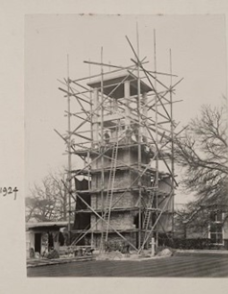
One of the central features of London Road Campus is the Clock Tower war memorial. The memorial was erected to in 1924 to commemorate the Staff and Students who gave their life serving in WW1. Most of those originally written on this war memorial were of upper-class students, however in 2018 a ‘Readings Connection’ project was carried out which aimed to add to the war memorial. They found 9 new names to add and 2 of these were of working-class professional staff members or their dependants. These include Frederick Aubrey, a waiter and Charles Henry Thomas, the laboratory boy.