
To celebrate Reading University's Centenary, PHD student Sharla Attala conducted interviews with several past and present working-class staff members to find out about their experiences of working at the university. The interviews cast light on the complex issues faced by working-class academic staff members in the university system and how these have changed over time.
Lack of Working-Class representative in the Workplace
-
Many staff members interviewed reflected on their time at university as working-class students and explained how there seemed to be little to no academic staff members who were working-class. This, many argued made entry into the academic workplace seem unattainable.
‘I assumed because they are professors in academia, they were probably middle-class.’
Many current working-class staff members who were interviewed explained how this has encouraged them to be more open about their working-class identity to their students as they realise how isolating it can be when this representation is hidden.
‘Teaching and wearing my working-class background as part of my identity has meant I’ve come back to myself a little bit.’
‘I hold it quite like a placard for that reason of enabling others to open up.’
-
Financial Barriers in Higher Education
To get to their role as academic staff members, many also had to complete PHD’s. Many found that once embarking on their PHD’s the financial support they had received as undergraduates seemed to stop. A PHD costs over £20,000 to complete making it simply not financially viable for many working-class students and although scholarships are available, they are very competitive. This means that many working-class students do not get a chance to complete higher levels of education.
‘An undergrad degree is pretty much available for everyone right? But it's when the funding stops that you can’t progress into a master's or a PHD.’
‘It was only with the PHD that class became solidified, and who was and wasn’t allowed in academia.’ -
Internal Activism
Positively however, many of the current working-class staff we talked to express a desire to help future generations of working-class students to reach academia. Staff members are expressing their working-class roots in lectures and opening up discussions about class struggles. This will really help working-class students of today feel heard and appreciated in the academic environment.
‘I really found value in helping other working-class people into academia, because I didn’t have that’
‘It’s political in terms of not bringing the ladder up with you and helping others’
‘I feel I’m in a position where I can make a difference to working people’
‘I’ve set up mentorship schemes, chair prizes and sit on panels for scholarships’
‘I hold it quite like a placard for that reason of enabling others to open up.’ -
Imposter Syndrome
Another common theme from the interviews was that many staff members felt a sense of ‘imposter syndrome’ within the academic workplace. This is because universities often have an upper-class culture and foster social ideas and behaviours that are unfamiliar to the working-classes. This caused many of the staff interviewed to feel the need to change themselves to fit in, and mask things such as their accent.
‘Me and other working-class colleagues have talked about imposter syndrome and feeling like you’re always trying to prove something to yourself and other people subconsciously.’
‘It’s like feeling torn between two different worlds and not feeling I fit into either of them.’
‘Throughout my career I’ve had to be several different people to get where I’ve got, in order to only then go back to being who I actually am.’ -
Community
Despite this however, many spoke about the positives of Reading specifically when it comes to the working-class, expressing how the university has always nurtured a sense of community and understanding not present in other institutions.
‘Because of Reading and my PHD, I have a much better understanding of where I came from, why so many things happened, and therefore a better understanding of where I am going’
‘University of all the spaces I have occupied since I left home has been one of the most open and welcoming spaces available. It’s one of the reasons why I wanted to stay forever because it feels like a progressive, open, warm community.’
There is undoubtedly still room for improvement, but the first crucial steps have already been taken towards a more class-conscious environment.
Professional Staff
It is important to note that it is not just academic staff who help run institutions such as Reading University but also many working-class professional staff such as: Cleaners, Chefs, maintenance and admin teams. Unfortunately, in our interviews we did not get to hear the voices of many professional staff members, but further research has found that they also face several class-related issues.
-
Institutional Hierarchy
Many working in the professional sector of universities report feelings of an institutional hierarchy where the academic staff are seen as ‘greater than’ professional staff. It has been expressed that there is the assumption that academic staff are of a ‘higher class’ and more intelligent than professional workers when this is not the case. Many professional workers have also attended university and have achieved just as well academically despite not taking on an academic role.
-
Underappreciation
It has been reported that professional staff members also often feel underappreciated for the work they do, with their vital work behind the scenes often being ignored.
-
Lack of Workplace Cooperation
Many professional roles require cooperation with academics. For example, technicians often must work with lecturers in science labs to ensure health and safety protocols are kept. It has been reported however that academic staff often see academic and professional roles as separate entities and find it hard to work together with professional staff members. This again makes professional staff feel ‘lower than’ academics and as if their skills are not valued. Work culture for academics and professional staff can also create a divide. Often, they eat lunch in separate areas and do not communicate, increasing the class divide and making cooperation when it does occur even more difficult.
Professional Staff at Reading
Working-class professional staff members have been key to running Reading University ever since its inception. Whilst exploring the archives we found some rare photographs and examples of past professional staff members that have worked at the university.
-
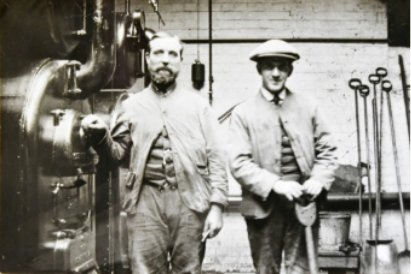
Photograph of Edward J Godden and Frederick T Millard, two engineers at the University Extension College.
From: ‘Stoking the Boilers’, Tales from the archives: Snapshots of early academic life at Reading, [blog], (November 22nd, 2022),
https://blogs.reading.ac.uk/tales-from-the-archives/category/london-road-campus/page/2/
(Last accessed: 13/01/2026)Edward J Godden and Frederick T Millard were both engineers at the University College. Edward J Godden began work at Reading in 1907 as a porter before becoming an engineer. Although this photo is not dated, we can assume it is pre-university charter showing how long professional staff have been making an impact at Reading.
-
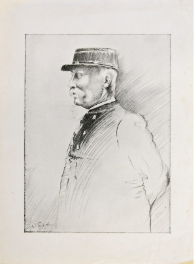
Undated Sketch of George Lucking, Head Porter at London Road.
From: ‘On Armistice Day’, Tales from the archives: Snapshots of early academic life at Reading, [blog], (November 11th, 2022),
https://blogs.reading.ac.uk/tales-from-the-archives/category/london-road-campus/page/2/
(Last accessed: 13/01/2026).This is an illustration of George Lucking, originally the porter of the College buildings in Valpy Street and then head porter of the new London Road Campus when it opened in 1907. He retired in 1924.
-
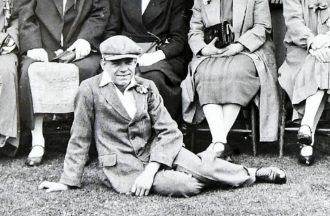
Snapshot from a 1920’s photo of staff before a seaside excursion.
From: ‘A Day at the Seaside’, Tales from the archives: Snapshots of early academic life at Reading, [blog], (November 19th, 2021),
https://blogs.reading.ac.uk/tales-from-the-archives/category/london-road-campus/page/3
(Last accessed: 13/01/2026).This is a photograph of Vanderburg R Wallace, the ‘Letter Boy’ in the 1920’s. ‘Boy’ reflecting status rather than age. In a time long before technology, he would have ensured letters got delivered and received and that communication in the University ran smoothly.